
Ancient Exercises Compared
Five Tibetans, Tai Chi, and Sun Salutations — comparing ancient practices to see what the body actually needs right now.

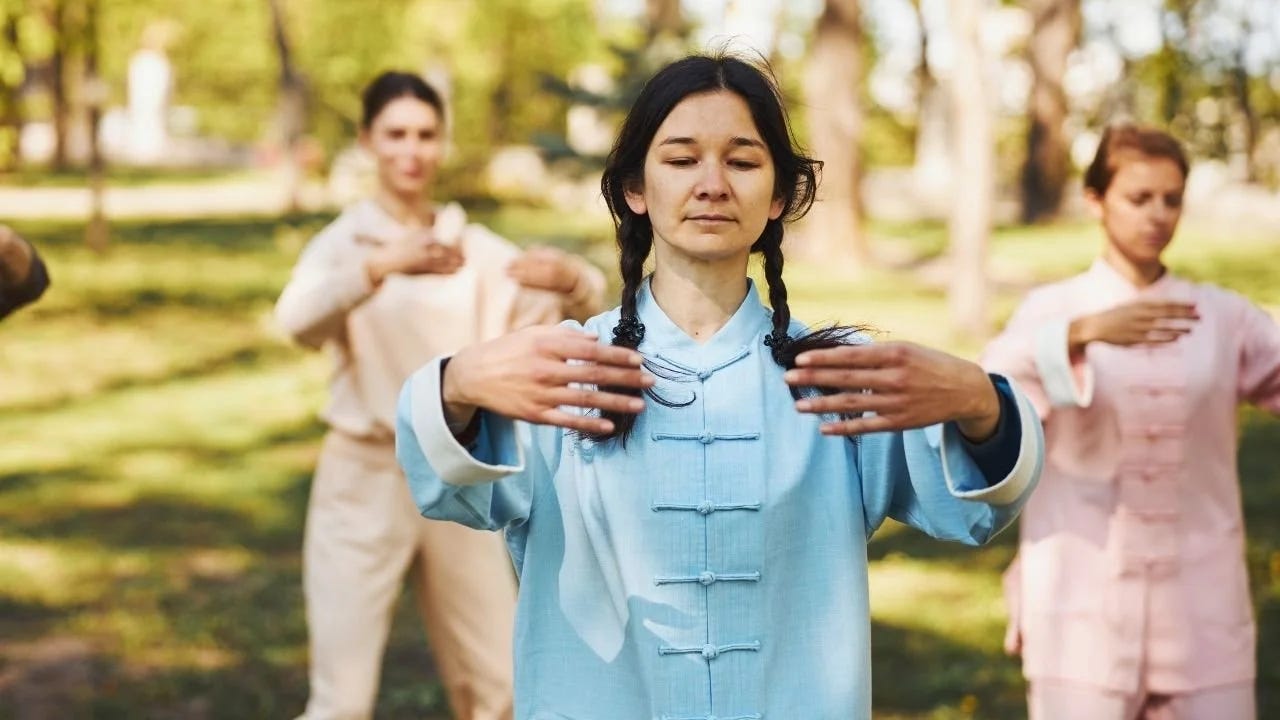
Well, if you know me at all, you’ll know by now that I’m always curious about how ancient systems compare with the modern ones, because… yes, I do suspected that our ancestors understood things we’ve forgotten.
And lately—if I’m honest—I’ve been a bit slack. The war has left me feeling rather low, (understatement) and I realized I needed a small pattern interrupt. So I thought: perhaps a little exercise.
But which one?
I’m a qualified yoga instructor, so yoga is the obvious default. I’ve also practiced and loved Qigong, which was very much on the table. And then there are The Five Tibetans, which I came across early in life and have always found intriguing.
So I started wondering: what would actually be best for me right now?
Naturally, this turned into a full analysis—energy body, fascia, lymph, nervous system and all—which I’ve posted below. With one small warning.
I also asked Chat for a sponge cake recipe…yeah….nah….yuk
So take it with a grain of salt : )
The Five Tibetan Rites, Surya Namaskar (Sun Salutations), and Ba Duan Jin (often called the “8 chains” or “Eight Brocades”) are all energy practices, but they affect the body through different mechanisms.
They are almost like three different technologies of movement.
The Core Difference
Five Tibetans
Dynamic spinal pump
Purpose:
stimulate circulation
activate the nervous system
load fascial elasticity
Effect:
energizing
Sun Salutations
Continuous mobility flow
Purpose:
warm muscles
lengthen fascia
synchronize breath and movement
Effect:
balancing and conditioning
Eight Brocades Qigong
Slow tension wave system
Purpose:
open meridians
regulate organs
build internal pressure
Effect:
internal energy cultivation
The Three Systems and the Energy Body
The three practices you looked at—
Five Tibetan Rites,
Surya Namaskar, and
Ba Duan Jin—each interact with the subtle body in a distinct way.
Very roughly speaking, they correspond to three different energetic operations:
charging
circulating
balancing
1. Five Tibetans — Charging the Energy Body
The Five Tibetans are essentially a dynamic energy generator.
In Tibetan and yogic frameworks, energy in the body (often called prana) tends to stagnate unless it is moved strongly through the central axis of the body.
The rites repeatedly:
flex and extend the spine
compress the abdomen
invert the body
stimulate the vestibular system through spinning
In energetic language, these movements stimulate the central channel—the vertical axis that many traditions describe as the primary conduit of life force.
Practitioners often report sensations such as:
heat rising up the spine
buzzing or tingling in the body
increased alertness
emotional brightness
In subtle-body terms, the Five Tibetans appear to increase the amplitude of the system. (I LIKE THIS!)
They raise the energetic charge. (GOOD FOR MAGICK!)
This is why people often feel suddenly awake or electrically alive after doing them.
But charging alone is not enough. A system that only increases charge can become unstable or scattered.
Which leads to the second type of practice.
2. Eight Brocades — Circulating the Energy
The Eight Brocades Qigong work very differently.
Instead of rapidly increasing energy, they emphasize slow, continuous expansion and contraction of the body combined with deep breathing.
In Chinese energetic theory, qi flows through a network of channels known as meridians. These pathways can become blocked by tension, emotional stress, or physical stagnation.
The slow stretching movements of the Eight Brocades:
open joints
lengthen fascial lines
create pressure waves through the abdomen and chest
Energetically, this is understood as opening the channels so energy can circulate. (ALSO VERY GOOD)
Rather than increasing the charge dramatically, the practice redistributes existing energy throughout the system.
People often feel:
warmth spreading through the limbs
pressure or fullness in the hands
deep calm
grounded strength
In energy-body language, Eight Brocades are less about generating energy and more about restoring flow.
The organism begins to feel coherent again.
3. Sun Salutations — Balancing the Field
The Sun Salutation sequence sits somewhere between the other two.
Its rhythm of forward folds, backbends, and plank-like postures moves the body through alternating compression and expansion.
In yogic energetic models, prana moves through nadis—subtle channels that distribute energy through the body.
Sun salutations tend to activate the two primary polar currents often symbolized as:
ida (cooling, inward, lunar)
pingala (warming, outward, solar)
The alternating spinal movements and breathing patterns gently synchronize these two currents.
Energetically, the practice acts like a regulator. ( NEED THAT)
It smooths the fluctuations of the system and brings opposing energies into balance.
This is why sun salutations often produce a feeling of:
emotional equilibrium
calm vitality
centered awareness
They don’t usually produce the dramatic “charge” people feel from the Five Tibetans, nor the deep internal pressure sensations of qigong.
Instead they create stability in the energetic field.
The Three Energetic Operations
Seen together, the three systems look less like competing exercise methods and more like complementary energetic technologies.
Five Tibetans — Charge the system
Eight Brocades — Circulate the energy
Sun Salutations — Balance the field
This forms a surprisingly elegant triad. ( ME LIKEY)
A healthy energy body requires all three processes:
• energy must increase
• energy must move
• energy must stabilize
If one of these functions dominates, problems begin to appear.
Too much charge without circulation leads to agitation.
Too much circulation without sufficient charge leads to fatigue.
Too much balancing without movement leads to stagnation.
The older traditions seem to have understood this intuitively.
Which may be why so many cultures developed short daily practices that combine activation, circulation, and regulation within a single sequence.
Movement Speed
Five Tibetans
Fast and repetitive.
Works like a cardio-fascial pump.
Sun Salutations
Moderate flowing speed.
More like moving stretch therapy.
Eight Brocades
Very slow.
Each movement takes 10–20 seconds.
This allows deep nervous system engagement.
Fascial Effect
Five Tibetans
Focus on elastic recoil.
The fascia behaves like a spring.
Good for restoring youthful bounce.
Sun Salutations
Focus on lengthening fascia.
Good for:
flexibility
joint mobility
muscle balance
Eight Brocades
Focus on fascial tensioning.
The movements create long tension lines through the body.
Example:
One Brocade stretches the body upward and downward simultaneously.
This creates continuous fascial traction, which is believed to stimulate meridian channels.
Nervous System
Five Tibetans
Strong stimulation.
Activates:
vestibular system
spinal nerves
circulation
People feel charged afterward.
Sun Salutations
Moderate activation.
Balances sympathetic and parasympathetic systems.
You feel centered.
Eight Brocades
Deep parasympathetic activation.
Slow breathing and tension create:
calmness
focus
internal awareness
This is why Qigong practitioners often feel quiet but powerful afterward.
Internal Pressure
This is where Qigong is different.
Eight Brocades create internal hydraulic pressure through:
breath
fascia tension
organ compression
This stimulates:
lymph flow
blood flow
internal organs
Traditional Chinese medicine calls this moving Qi through the meridians.
Energy Sensations
Five Tibetans
Energy feels like:
buzzing
heat
alertness
Very yang.
Sun Salutations
Energy feels like:
warmth
openness
flow
Balanced.
Eight Brocades
Energy feels like:
pressure
fullness
quiet strength
More yin.
Structural Emphasis
• Five Tibetans — spine
• Sun Salutations — muscles & joints
• Eight Brocades — fascia & organs
Time Investment
Five Tibetans
5 minutes
Sun Salutations
10–20 minutes
Eight Brocades
15–20 minutes
The Interesting Hidden Pattern
If you compare them biomechanically:
Five Tibetans stimulate the central axis (spine).
Sun Salutations stimulate the outer body (muscles).
Eight Brocades stimulate the internal body (organs + fascia).
Together they cover the three major layers of the human system.
Interesting huh! I have also been trying to get the damn lymph to flow…so…
1. Five Tibetan Rites
Strong lymph stimulation
The Five Tibetans are surprisingly good for lymphatic flow because several of the movements act like mechanical pumps.
Key mechanisms
Spinal pumping
Flexion and extension compress the thoracic duct (the main lymph channel).
This helps push lymph upward toward the chest.
Inversion
The up-dog/down-dog style movement helps drain lymph from legs and pelvis.
Repetition
Repeating the movements 10–20 times creates rhythmic pressure waves.
Vestibular stimulation
Spinning increases circulation and fluid movement.
Where lymph moves most
spine
abdomen
legs
So the Tibetans tend to stimulate central lymph flow.
2. Surya Namaskar
Moderate lymph movement
Sun salutations move lymph primarily through muscle contraction and joint motion.
Key mechanisms
Large muscle activation
Legs and arms act as pumps for lymph vessels.
Alternating compression
Forward folds compress the abdomen.
Backbends open the chest.
Breathing rhythm
Deep breathing pulls lymph toward the thoracic duct.
Where lymph moves most
limbs
chest
shoulders
Sun salutations are particularly good for peripheral lymph circulation.
3. Ba Duan Jin
Excellent for gentle lymph drainage
The Eight Brocades work through slow fascial tension and breathing pressure.
Key mechanisms
Fascial traction
Slow stretches open lymphatic vessels embedded in fascia.
Diaphragmatic breathing
Deep abdominal breathing acts like a lymph pump.
Organ compression
Several movements compress the liver, spleen, and stomach areas where lymph is processed.
Joint opening
Gentle stretching opens lymph channels near joints.
Where lymph moves most
abdomen
organs
chest
Eight Brocades are very good for visceral lymph movement.
If your goal is lymph health
The ideal order is actually:
Eight Brocades – open vessels
Five Tibetans – pump lymph
Walking or yoga – circulate fluid
This mimics how manual lymph therapists work:
open → pump → move.
Super interesting, isn’t it—the idea that in perhaps twenty or thirty minutes one could touch so many systems in the body so efficiently.
What fascinates me about these older movement traditions is that they rarely approached the body the way modern exercise science does. Today we divide things into categories: cardio, strength, flexibility, lymphatic health, nervous-system regulation. Each problem gets its own protocol, its own piece of equipment, its own specialist.
But these older practices seem to have been designed very differently. A small sequence of movements—repeated daily—quietly engages multiple systems at once. The spine moves through compression and extension. Breath deepens and begins to regulate the nervous system. Fascia lengthens and recoils. Circulation increases. Lymph begins to move. Balance and spatial awareness are stimulated.
In other words, a short practice becomes less like “exercise” and more like a daily recalibration of the organism.
And the efficiency of that is striking.
You can imagine that in cultures where people did not have an hour to spend at the gym, practices that worked quickly would have been far more valuable. Something simple enough to remember, short enough to do every morning, yet sophisticated enough to keep the body functioning well over decades.
That’s a pretty elegant piece of human engineering.
I think I will try all three : )
Oh….and here is my other point…
Exercise is one kind of pattern interrupt.
But sometimes the pattern that needs interrupting isn’t in the body.
It’s in the structure of our lives.
Which may explain why I made a sponge cake for the first time in thirty years.
A small interruption in the pattern.
And yes—it tasted awful. But the making of it was lovely.
Which, in a way, is the entire premise behind SHIFT.
Something I’ve been wanting to share for a long time—especially if the last few weeks have left you feeling a bit like I have.
So I’m running a small lab.
SHIFT.
Three weeks.
Three experiments.
Inside the patterns of your own life.
Because when a pattern breaks, something interesting happens.
Magick.
https://offers.magicalegyptstore.com/shift
Prophet Muhammad did teach that each joint has a daily right over us and a spiritual purpose, but people forget the importance of variety. We find those who live past 100 were those who kept moving more than in and out of seats; especially when it gets past 120.
Thanks for this fantastic Breakdown ! I shall copy to a file and then learn the 8 brocades, which seem simple , having done various Chi Kung routines. Isn’t it great that a decent YouTube can reveal a lot?Especially when one is not in Brooklyn or Pasadena, or Chippendale.
I came across a great guided pranayama exercise on YouTube :
Ananda Mandala
https://youtu.be/OgFF0jewIiM?si=WKQJKSJu7zjH1fnz
It’s 30 minutes and amazing for mental clarity and feeling one’s chi buzzing away blissfully.
A separate Tibetan exercise I learned 15 years ago is a minimum daily- inhale deep, vigorously , raising arms above head for as many times as you have years…. So it ups the ante as you age!